System Architecture
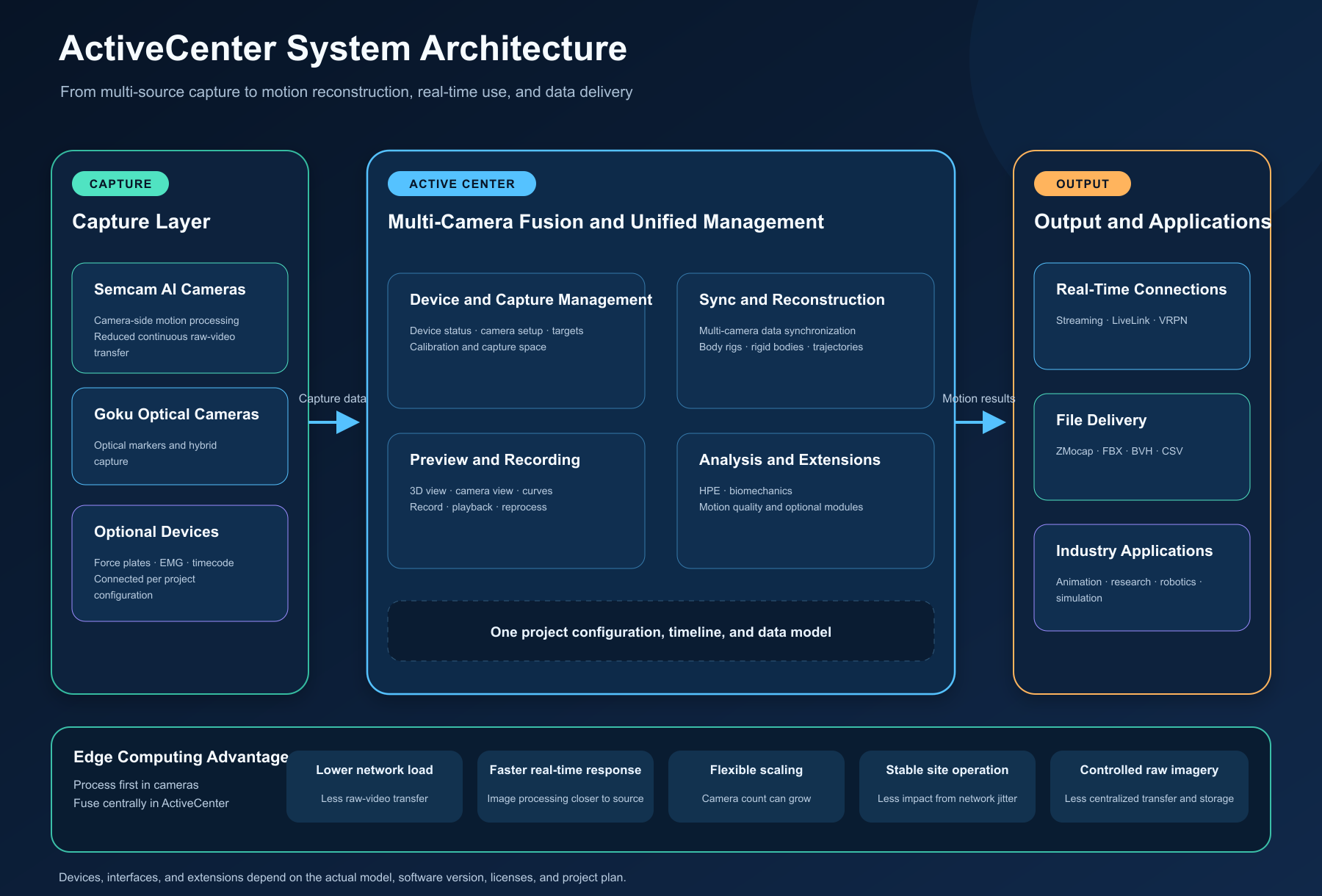
ActiveCenter uses an edge computing architecture: Semcam AI cameras process image information at the device first, then ActiveCenter performs synchronization, motion reconstruction, visualization, and output. This balances real-time performance, deployment scale, and site stability.
Overall Flow
The system collects data from cameras and external devices, processes it in ActiveCenter, and delivers it to real-time preview, recording, offline analysis, or third-party software.
- Capture: Semcam AI cameras, Goku optical cameras, and optional devices record human or rigid-body motion.
- Synchronization: ActiveCenter aligns device data to one timeline.
- Processing: The system reconstructs body rigs, rigid-body poses, and trajectories.
- Application: Results can be used for preview, playback, HPE processing, or business analysis.
- Output: Data is streamed or exported to downstream software.
Why Edge Computing Matters
Conventional systems often send multiple raw video streams to a central workstation. Semcam Live moves part of that computation to the camera, sending motion-related data to ActiveCenter for fusion and management.
- Less continuous raw-video traffic on the network.
- A shorter path from capture to real-time result.
- Compute capacity grows as cameras are added.
- Camera-side processing and buffering improve site robustness.
- Raw video transfer and storage can be reduced when the project allows it.
- Real-time operation and HPE post-processing can coexist.
Capture Layer
Semcam AI Cameras
Semcam AI cameras perform image analysis on the device and send motion data to ActiveCenter, reducing network pressure and supporting multi-camera deployment.
Goku Optical Cameras
Goku optical cameras capture optical markers and can be used alone or together with Semcam in a hybrid capture system.
External Devices
Depending on the project, the system can include force plates, EMG, and timecode devices. ActiveCenter manages these devices within the same capture task and keeps their timing consistent.
ActiveCenter Core
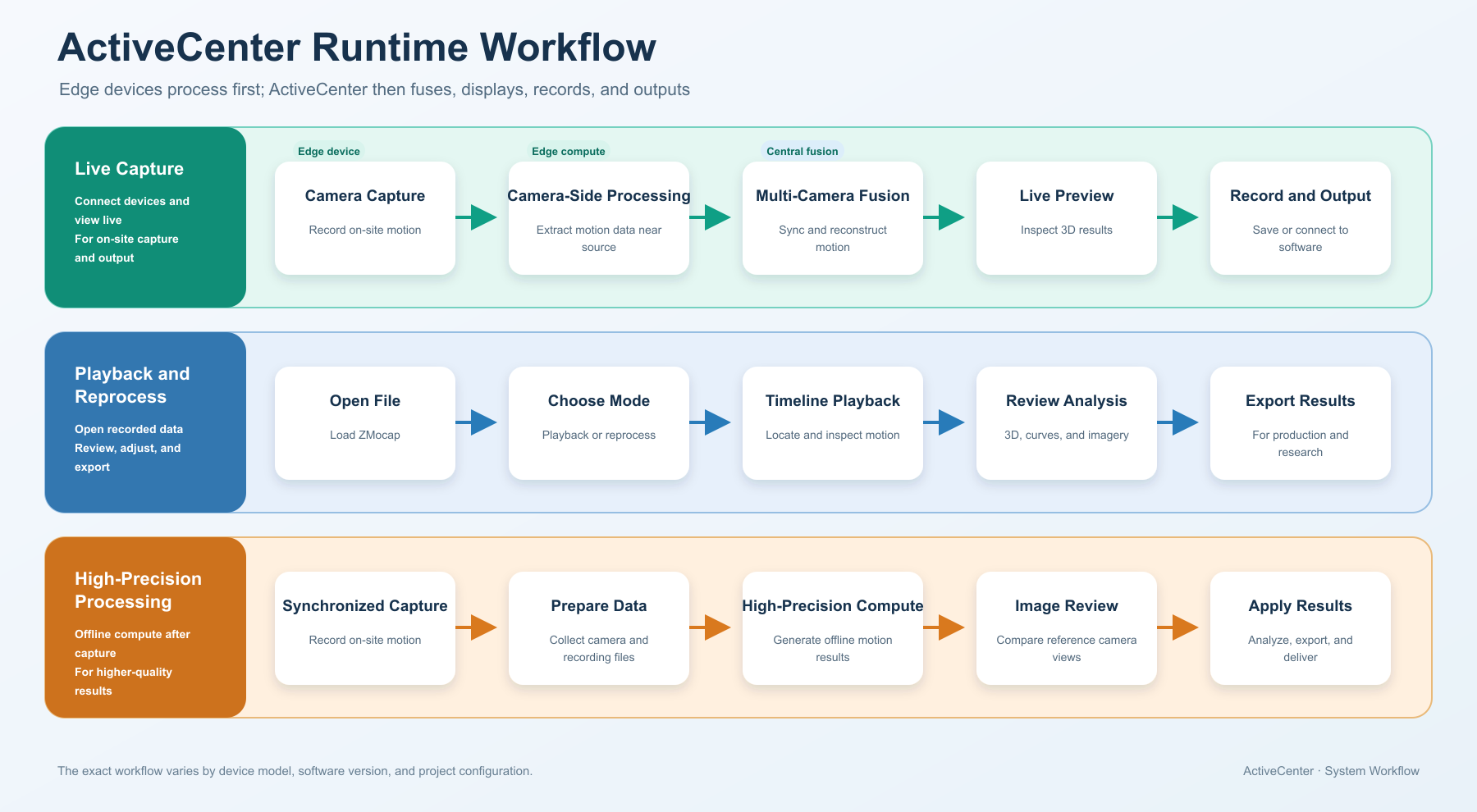
ActiveCenter manages devices, calibration, capture targets, body rig reconstruction, rigid-body trajectories, real-time preview, recording, playback, reprocessing, output, and optional analysis modules. Live capture, file playback, and reprocessing use a consistent display and output model, making comparison easier.
High-Precision Processing
For tasks requiring higher-quality results, HPE can process selected recordings after capture. It combines camera-side data and ActiveCenter recordings, and reference images can be used to check correspondence between motion results and original footage.
Output and Applications
ActiveCenter can stream through real-time protocols, Unreal Engine LiveLink, or VRPN; save ZMocap source data; export FBX, BVH, MOT, CSV, and related formats; connect optional modules such as Active Biomechanics and motion quality assessment; and provide motion data for animation, life sciences, robotics, simulation, and large-space interaction.
Delivery Boundaries
Deployment should be based on site size, camera count, network conditions, target software, and project goals. Devices, interfaces, file formats, and extensions described here are subject to the contracted model, software version, licensed modules, and delivery plan.