Why Semcam Live is not an ordinary video mocap tool
Generating animation from a video and continuously outputting motion data from a space are two different products. Semcam Live turns on-site motion into real-time, recomputable, workflow-ready data.
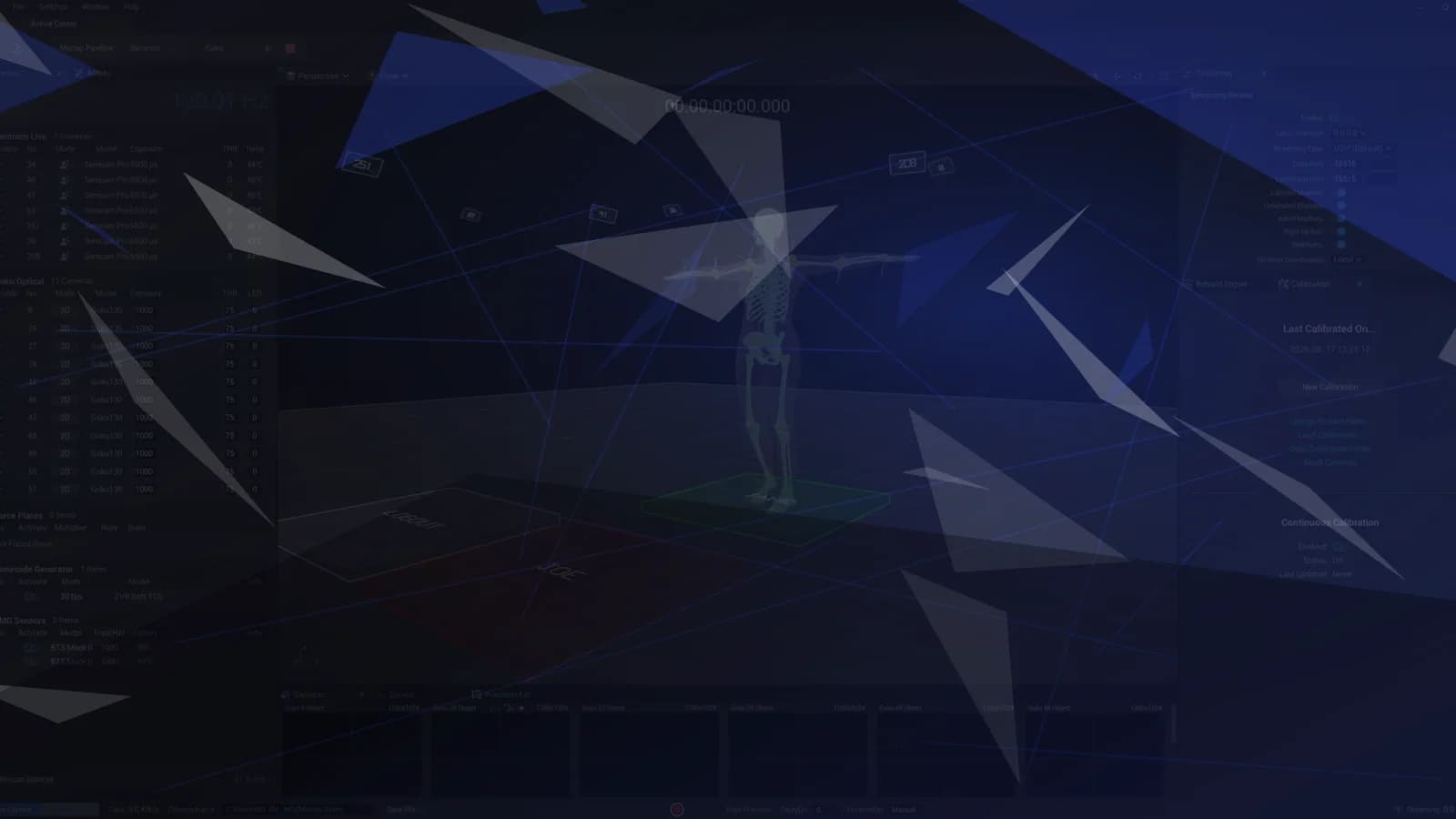
Core view: generating animation from a video and continuously outputting motion data from a space are two different products. The core value of Semcam Live is not making video processing look more like animation. It is using synchronized multi-camera capture, edge AI, local 3D reconstruction, and open interfaces to turn on-site motion into data that can be used in real time, recomputed after capture, and brought into industry software.
1. Both may be called “AI mocap”, but they solve different tasks
Many users first encounter AI motion capture through phone recording or short-video upload. An actor performs in front of a camera, the platform estimates human pose from the image, and after processing generates a body rig or FBX file. The main advantage of this workflow is that it is lightweight: there is no need to purchase a full camera array or build a dedicated venue, and independent animators, game teams, and content creators can quickly obtain a usable motion draft.
The product logic of ordinary video mocap usually centers on “one asset task”: input a video and obtain an animation result. Users care whether upload is easy, how long processing takes, whether hands and feet are stable, whether foot locking is automatic, whether the output body rig is compatible, and how billing works by seconds or credits. These tools are valuable, especially for fast previs and lightweight content production; but their design center is usually a one-off content asset, not continuous measurement in a fixed space.
Semcam Live addresses another class of problem: how can a laboratory, robotics data field, training center, or interactive space capture stably every time someone enters? How is identity maintained when multiple people cross? How is motion data sent to applications in real time? How do the human body and tools stay in the same coordinate system? Can sensitive video remain on site? After capture, can key clips be processed at higher precision? These questions cannot be answered only by “uploading a video,” because they involve synchronization, calibration, compute allocation, networking, latency, object fusion, interfaces, and operations.
2. First essential difference: the input is not one video, but a synchronized multi-view scene
Monocular video sees only one viewpoint. When a person turns sideways, turns around, an arm passes across the torso, two people occlude each other, or a prop hides a joint, the algorithm must rely on training data and temporal priors to infer invisible parts. Inference is sometimes good enough, but in professional measurement users need to know whether results come from real geometric constraints or model completion. A multi-camera system observes simultaneously from different angles and recovers 3D positions through camera calibration, time synchronization, and triangulation. In theory, this can provide more observational evidence for occlusion recovery and spatial localization; actual performance still depends on camera layout, synchronization accuracy, calibration, models, and motion conditions.
On the Semcam Live camera side, detection, tracking, segmentation, 2D keypoints, ReID, and confidence calculation are completed; Active Center locally completes cross-camera matching, triangulation, 3D keypoints, joint-based solving, IK, filtering, and retargeting.[1][2] This means we are not simply sending multiple video streams to one computer for unified processing. Instead, part of visual computation is distributed to the capture end, and structured results are sent to the center. We call this layered collaborative approach an edge AI architecture.
The commercial meaning of this architecture is that the “space can be operated.” After fixed cameras are installed and calibrated, the venue can be reused repeatedly, without finding phone positions again each time or requiring every participant to wear the same equipment. For university teaching, students can complete multiple capture groups in one class; for training centers, athletes can repeat tests under similar conditions; for robotics teams, demonstrators can perform multiple rounds of tasks continuously; for LBE, the system can run for batch after batch of players. Whether this continuity is truly achieved still requires project validation, but the product goal is clearly different from per-video processing.
3. Second essential difference: computation happens on site, not by default in the cloud
Cloud computation has advantages: elasticity, easy updates, and a low upfront hardware threshold. OpenCap uses phone video and cloud processing to bring kinematic and dynamic analysis to broader research and clinical scenarios, and its public paper describes devices, camera positions, samples, and error.[3] Therefore, “cloud” itself is not a disadvantage. The issue is that some customer sites do not allow video to leave the intranet, or network quality, latency, and continuous operation requirements make the cloud unsuitable as the only link.
Semcam Live emphasizes fully local deployment. Active Center manages real-time reconstruction, projects, HPE processing, and data export on site. The camera side transmits structured data such as frame-aligned keypoints and confidence, rather than uploading all HD video to a public cloud by default.[1][2] This helps reduce sustained multi-stream video processing pressure on the center side and reduces the need for public-internet transmission. NIST’s conceptual model for fog/edge computing also notes that distributed processing can address the scale, heterogeneity, and high-latency issues of IoT systems in some cloud environments.[4]
However, localization must not be written as “naturally secure.” Local servers may still have risks in permission configuration, backups, patches, accounts, and physical access; structured body rig data may also involve personal and behavioral information. The correct expression is: a local architecture gives organizations more direct data boundaries and operational control, but security ultimately depends on complete governance. We will publish data-retention policies, account permissions, logs, offline upgrades, whether video saving can be disabled, and export audit information, rather than only saying “data is not uploaded.”
4. Third essential difference: serving both real-time use and high-quality post-capture delivery
Ordinary video mocap often defaults to process first and use later. For animation assets, this is entirely reasonable; but real-time virtual characters, robot teleoperation validation, training correction, multi-person interaction, and on-site director preview need low-latency output. Our currently public information shows that PRO, PRO+, and ULTRA all target 120fps, with end-to-end latency below 100ms.[1] These parameters must be understood together with the specific test link: during project acceptance, it should be clear whether camera exposure, network, center solving, protocol sending, and target application receiving are all included in the measurement.
Real time does not automatically equal highest precision. We separate the two links: real-time solving on site supports interaction and quality checks, while the HPE high-precision extension performs non-real-time processing after capture. Our currently public information shows that HPE keypoint error can reach below 1 cm; this metric still needs to be understood together with dataset, motion, camera count, capture distance, occlusion, clothing, and error definition.[1][2] Therefore, our wording is: the same capture system supports both real-time feedback and post-capture precision enhancement, with specific performance subject to test protocols and project acceptance.
This dual-link approach is practical for professional customers. Robotics experiments can use real-time body rigs to check whether demonstrations were fully recorded, then recompute high-quality clips with HPE; animation teams can preview characters on site and refine key shots after capture; life-science laboratories can use the real-time view to detect leaving the capture volume or occlusion, then use formal trials for high-precision analysis. It manages “whether there is a result” and “whether the result is worth delivering” as two stages.
5. Fourth essential difference: markerless human capture and high-certainty rigid bodies are placed in one project
The typical output of video mocap is a human body rig, but professional sites often also need to know where objects are. Robot imitation learning needs to record human hands, robot end effectors, and tools; simulation training needs to record trainee bodies, instruments, and task objects; LBE needs to track player bodies, headsets, controllers, and props; virtual production needs to synchronize actors, weapons, and cameras. Seeing only the human body is not always enough to explain the relationship between motion and task outcome.
Semcam Live can be fused with the ZVR Goku optical system: the AI markerless link handles the human body, the optical link handles rigid-body objects, and Active Center places both data types in a unified coordinate system and timeline.[1][2] This is not “all objects are markerless,” but a deliberate division of labor by object. The 0.1 mm we mention is joint-calibration accuracy, not human tracking error, and should not be used as a unified accuracy figure for the whole system.
The advantage of this combination is not only precision, but semantic completeness. With only a human body rig, the system knows “the hand was raised”; with tool pose added, the system may determine “whether the hand held the specified tool, whether the tool reached the target area, and whether body posture followed the procedure.” For robotics, human motion still needs retargeting, constraints, and safety checks, and cannot be directly turned into joint commands; but unified temporal and spatial relationships can significantly reduce later alignment work and provide more complete raw material for imitation learning, teleoperation review, and human-robot collaboration research.
6. Fifth essential difference: the deliverable is not one animation file, but connected data
The value of a professional system ultimately appears inside the customer’s software. Our current listed outputs and interfaces include ROS, C++, Python, Matlab, MuJoCo, NVIDIA Isaac, OpenSim, Visual3D, C3D, Unreal Engine, Unity, Blender, Maya, MotionBuilder, as well as FBX, BVH, parametric body model, and high-precision body model.[2] Specific SDK versions, field definitions, coordinate conventions, timestamps, sample code, and support scope should follow the corresponding technical documentation and project validation.
Interfaces are not a “logo wall.” The ROS 2 Topic mechanism is used for publishing and subscribing to continuous data streams,[5] MuJoCo is a general-purpose physics engine for robotics, biomechanics, and machine learning,[6] and OpenSim is used for biomechanical modeling and motion analysis. If a system can stably output timestamped data with coordinate definitions and confidence, it may enter these environments; conversely, even if software names are listed, customers still cannot deploy without versions, examples, and technical support.
We will describe each interface as a specific task: how to publish real-time body rigs to ROS 2; how to import human and rigid-body trajectories into MuJoCo or Isaac; how to send C3D into Visual3D; how to retarget FBX to a character; how to read keypoints and confidence in Python. For professional customers, runnable tutorials, sample data, and version notes are more valuable than a compatibility list.
7. How to decide which product type you need
If your task is occasionally turning short videos into animation, your budget is limited, you do not have a fixed venue, and you can accept cloud processing and cleanup after the fact, ordinary video mocap tools are usually a more efficient starting point. When choosing, focus tests on camera conditions, hand and foot capture, foot locking, retargeting, formats, and usage-based cost. There is no need to buy a system beyond your needs for the word “professional.”
If your task requires multiple people, a fixed space, 120fps-class real-time output, local data boundaries, repeated capture across sessions, tool or device pose, ROS/OpenSim/real-time engine interfaces, and long-term operations, then Semcam Live deserves formal evaluation. Evaluation should not only watch demo videos; it should use the real venue and real motions for a proof of concept, recording camera count, coverage area, calibration time, occlusion, dropped frames, identity switching, output latency, cleanup labor, and interface stability.
Product status must also be included in the decision. Our currently public information shows that PRO supports 4 people, 18 meters, and real-time capture; PRO+ adds HPE and fingers; ULTRA is planned for 100 TOPS, 5.2 megapixels, 12 people, 45 meters, HPE, fingers, and face, but the FAQ still says “coming soon.”[1] Before ULTRA completes public delivery validation, we will clearly mark it as a pre-release or planned model. The Biomechanics Plugin and Action Quality Assessment Plugin are also not currently promised as fully delivered complete modules.
8. Conclusion: we deliver continuous motion-data capability
Semcam Live is positioned as a local edge AI multi-camera motion-data system for professional sites. Its differences from ordinary video mocap come from six levels: synchronized multi-view input, collaborative computation between camera side and center side, real-time and HPE dual links, human and rigid-body fusion, local governance, and industry interfaces. Therefore, we emphasize not only “no mocap suit required,” but whether a space can stably, continuously, and verifiably output motion data.
At the same time, system-level positioning requires stronger evidence responsibility. We will publish test conditions, failure boundaries, raw outputs, deployment tutorials, SDK samples, and customer outcomes. The most persuasive content is not “we are more professional than video mocap,” but showing how a robotics site, a life-science laboratory, or a training space runs completely from installation, calibration, capture, real-time use, to data analysis, and explaining every parameter inside the real task. Only then will customers understand that Semcam Live does not sell one animation generation, but the capability for a space to continuously produce motion data.