Why Semcam Live Delivers High-Precision, Low-Latency Solving
Semcam Live combines edge AI cameras, synchronized multi-view geometry, calibration, 250 keypoints, biomechanical constraints, and a local real-time pipeline.
Accuracy and real time start as system engineering
Semcam Live does not deliver high-precision, low-latency solving simply because one RTMO model is strong. In markerless motion capture, the AI vision model is only the entry point. Result quality depends on the full system: how cameras are synchronized, how the space is calibrated, how keypoints from each view are fused, how human joint-based constraints participate in optimization, and how final data is delivered with stable latency.
Mature multi-camera markerless systems show that computer vision combined with biomechanical constraints is usually more reliable than monocular pose estimation alone. Semcam Live builds on that foundation and moves edge computation into the camera, so the system can preserve precision while supporting real-time preview, interaction, robotics training, and large-space multi-person capture.
Multi-view capture reduces depth ambiguity
A single camera sees a two-dimensional image. It can detect where a joint appears in the frame, but distance from the camera, occlusion, and the true direction of a limb remain ambiguous.
Semcam Live observes the same motion from multiple synchronized cameras. If one view loses a joint, other views may still provide usable evidence. When several cameras see the same keypoint, the system can use geometry to reconstruct a more stable 3D position. Better view coverage and fewer occlusions create a stronger foundation for 3D solving.
Calibration turns 2D detections into 3D coordinates
For a multi-camera system to be accurate, the position, orientation, and lens parameters of every camera must be known. Intrinsics describe focal length, principal point, and lens distortion; extrinsics describe where each camera is located and how it is oriented in the capture volume.
After calibration, 2D keypoints from different views are no longer isolated pixels. They can be placed into one shared 3D coordinate system. The system uses multi-view geometry and triangulation to recover spatial keypoint positions, creating a consistent basis for body rig solving.
250 keypoints provide denser body-structure evidence
Tracking only a small set of coarse joints can make pelvis, ribcage, shoulder, arm-twist, and lower-limb orientation estimates unstable. Semcam Live can currently identify 250 body keypoints, giving the solver denser anatomical evidence than sparse body rigs.
Denser keypoints make it easier to estimate the 3D direction of body segments and maintain continuity under partial occlusion, clothing variation, and complex motion. Dense keypoints do not automatically equal final accuracy, but they provide stronger observations for high-quality joint-based fitting.
Human joint-based models and inverse kinematics reduce jitter
AI-detected keypoints are not used directly as the final result. Real bodies have stable bone lengths, connected segments, and joint ranges of motion. If visual keypoints are output frame by frame without constraints, bone lengths can change, joints can jitter, and poses can become anatomically implausible.
Semcam Live feeds visual results into a human kinematic model and fuses them with bone constraints, joint constraints, temporal continuity, and confidence estimates. The output is not a loose set of points, but smoother joint motion that better follows human structure.
Edge computing is key to low latency and large deployments
If a traditional vision mocap system sends every raw video stream back to a central server, bandwidth and central compute quickly become bottlenecks. As camera count grows, projects may need higher-spec switches, more complex cabling, or even 10GbE networks, increasing cost and failure points.
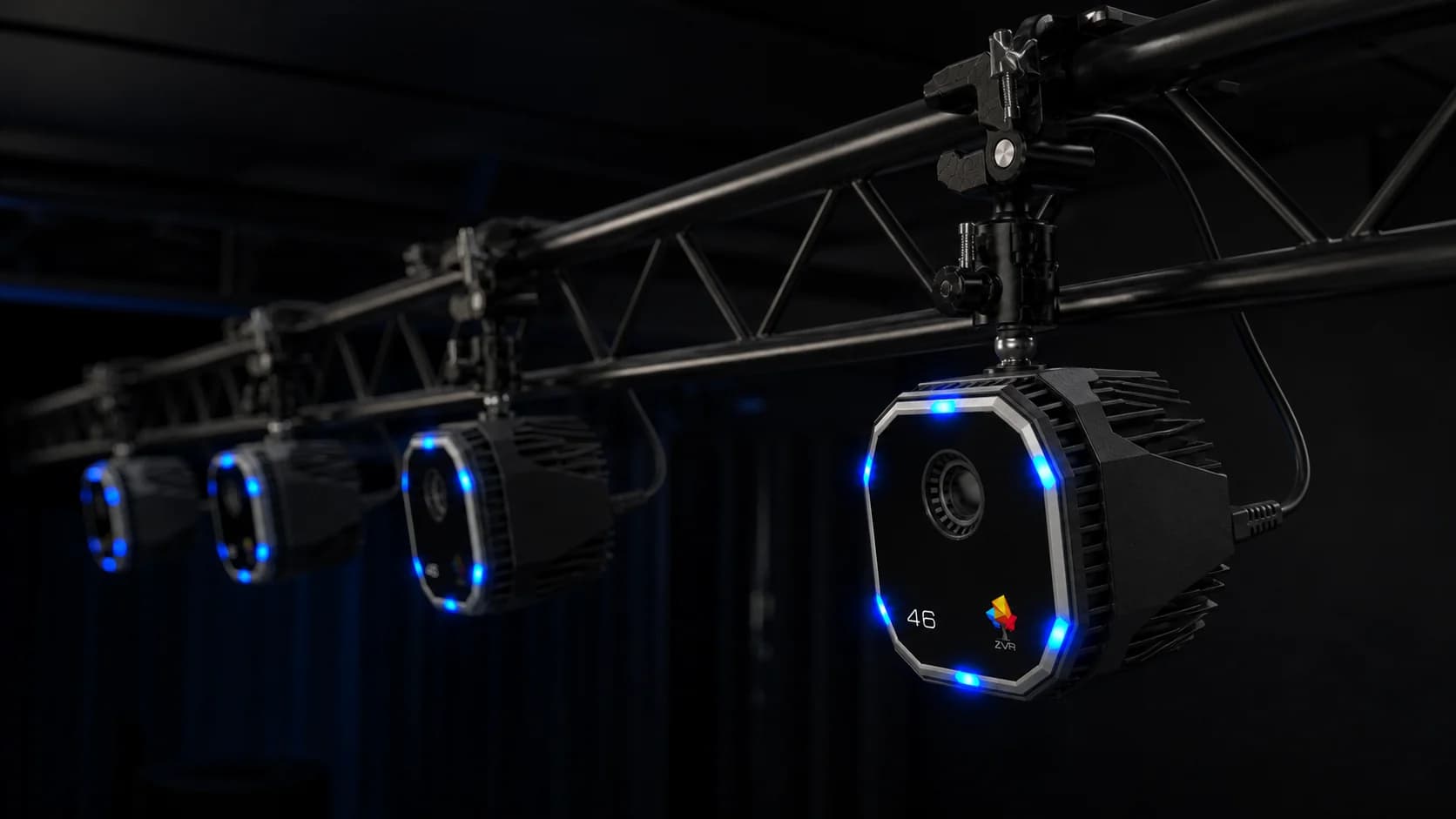
Semcam Live edge AI cameras process complex image features on the camera side, moving high-bandwidth vision computation to the source. The central system does not need to continuously ingest massive raw video streams. Instead, it receives lighter structured features and results, then performs multi-view fusion, identity tracking, and body rig output. This reduces network pressure and central queueing time, making a 120fps real-time pipeline with under 0.1 seconds of latency easier to keep stable.
Edge computing also makes large camera matrices more scalable. System design can focus more on coverage, occlusion, and synchronization quality instead of being limited first by video backhaul bandwidth. This is a key reason Semcam Live can support venues over hundreds of square meters, simultaneous multi-person capture, and complex on-site applications.
Markerless capture reduces marker-placement error sources
Traditional marker-based systems require operators to identify anatomical landmarks and attach reflective markers. Differences in marker placement, soft-tissue movement, clothing, and operator experience all enter the final error budget. Markerless systems are not error-free, but they remove the marker-placement step and make procedures more consistent across subjects, operators, and sessions.
For robotics training, virtual production, sports analysis, and large-space interaction, that consistency matters. It keeps capture closer to natural motion and helps the system enter production faster.
How to interpret high precision correctly
High precision must be understood in relation to scenario and metric. Multi-view coverage, good calibration, adequate lighting, reasonable camera placement, and limited occlusion are prerequisites for stable results. Overall motion, gait spatiotemporal parameters, and major sagittal-plane joint motion are usually easier to estimate reliably; small axial rotations, pelvis angles, fast occlusion, and extreme poses require careful evaluation in the actual environment.
A more precise statement is that Semcam Live combines edge AI, multi-view geometry, 250 keypoints, and human kinematic constraints to approach offline-level stability within a real-time system. The HPE high-precision solver further extends non-real-time processing for workflows that require higher-quality data.
Conclusion
Semcam Live achieves high precision and low latency through a complete pipeline: synchronized cameras provide multi-view observations, calibration maps images into one 3D space, dense keypoints provide enough body-structure evidence, kinematic models constrain visual results into plausible joint-based motion, and edge computing moves complex image processing to the camera side to reduce network and central compute pressure.
That is what separates Semcam Live from monocular pose estimation, pure video-backhaul systems, or solutions that emphasize only model size. Its performance is the result of camera, network, geometry, model, and software-output design working together.